
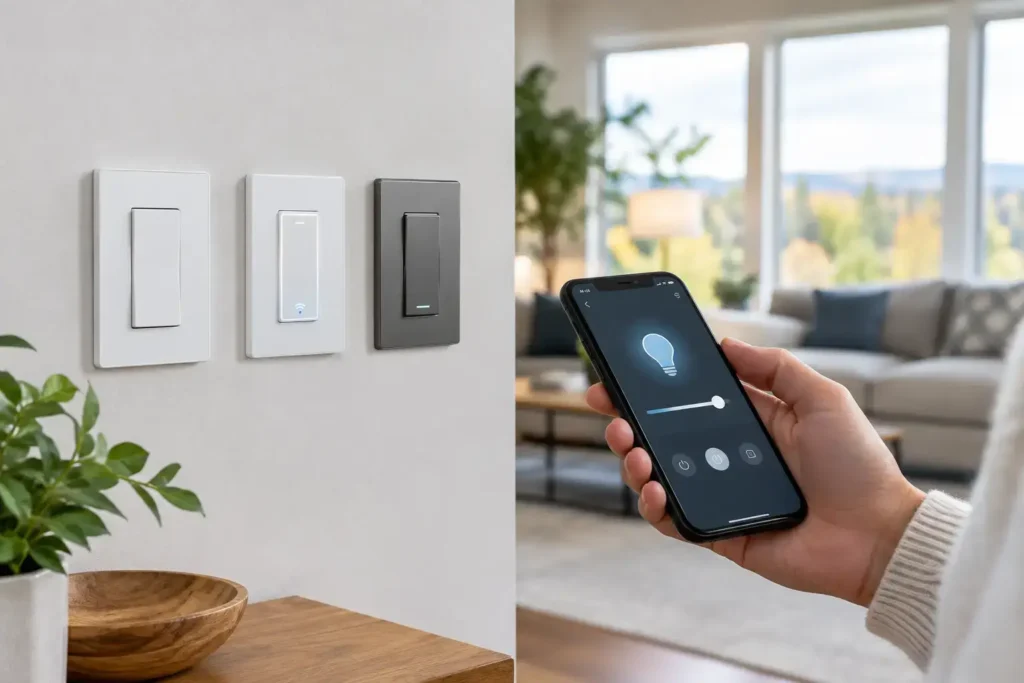
A smart switch comparison should start behind the wall, not with an app screen. In many Northern Virginia homes, especially properties built before the 1990s, the deciding factor is not whether a switch offers voice control or scheduling. It is whether the existing box has a neutral conductor, enough physical space, proper grounding, and wiring that can support the device safely.
Smart lighting controls can make a home more convenient, secure, and adaptable for a renovation. They can also expose aging wiring, crowded boxes, incompatible fixtures, and multiway circuits that deserve professional attention. The right choice depends on your electrical system, the lights you use, and how you want the space to operate years from now.
Smart Switch Comparison: Start With the Electrical Setup
Most hardwired smart switches replace a standard wall switch and connect to your home’s Wi-Fi network, a dedicated smart-home hub, or both. Unlike a basic mechanical switch, many models need continuous power for their internal electronics. That usually means they need a neutral wire in the switch box.
A neutral is commonly white, but wire color alone is never proof of function. In older homes around McLean, Vienna, Fairfax, and Arlington, power may enter at the light fixture rather than the switch box. The box can contain only a hot conductor and switched leg, even if the home has otherwise sound wiring. Installing a neutral-required switch in that location may require new cable or a different product approach.
Grounding matters as well. A grounded metal box may provide a grounding path in some older installations, but it must be evaluated correctly. A licensed electrician can identify the circuit configuration, verify box fill, inspect conductor condition, and determine whether the planned control meets current code requirements.
The neutral-wire question
A neutral-required switch is often the best fit when the box has modern wiring and the homeowner wants broad product choice. These models typically support more advanced features, including reliable status reporting, power monitoring, and integration with multiple smart-home platforms.
No-neutral smart switches are designed for boxes that do not include a neutral conductor. They can be useful in older homes, but compatibility is more limited. Some require a small component at the light fixture, and some can behave poorly with very low-wattage LED loads. The fixture, bulb type, and total connected load all need to be considered before installation.
Wireless companion controls are another option for a renovated space. A hardwired primary switch controls the circuit, while a wireless keypad or remote can be placed where additional control is useful without opening walls for new cable. This is particularly practical when adding a control point near a bed, patio door, or basement stairway.
Smart Switch vs. Smart Dimmer
A smart on-off switch is built for loads that should simply turn on and off: many ceiling lights, exterior lights, bathroom fans, and approved controlled receptacles. A smart dimmer is for lighting that is specifically dimmable and compatible with the control.
The distinction matters because LED fixtures do not all dim the same way. An LED lamp or integrated fixture may be labeled dimmable yet still flicker, hum, drop out at low levels, or fail to turn fully off with a particular dimmer. The dimmer must be rated for the lighting load and, in some cases, calibrated to the fixture’s minimum and maximum output.
For a kitchen renovation, a dimmer can give recessed lighting a useful evening setting while keeping under-cabinet lighting on a separate switch. For a front porch, an on-off switch with scheduling may be the more dependable choice. A dimmer is not automatically an upgrade if the lighting does not benefit from variable output.
Wi-Fi, Hub-Based, and Matter-Compatible Controls
Connectivity affects both everyday reliability and long-term flexibility. The three common approaches are Wi-Fi switches, hub-based switches, and products designed to work with Matter, a newer interoperability standard.
Wi-Fi switches connect directly to the home network. They are familiar, often easy to set up, and a good fit for a limited number of controls. The trade-off is scale. A home with dozens of Wi-Fi devices can place more demand on an older router or poorly planned network. Wi-Fi controls also depend heavily on strong coverage at the switch location.
Hub-based systems use a dedicated bridge or controller that communicates with switches over a separate low-power network. This can provide faster response, local control, and less demand on Wi-Fi. It is often the stronger choice for a whole-home lighting plan, particularly in larger homes with multiple floors, detached spaces, or thick plaster walls that can weaken wireless signals.
Matter-compatible products are intended to reduce brand lock-in by allowing supported devices to work across more than one major smart-home ecosystem. Compatibility still varies by device, controller, and feature set. A homeowner should not assume that a Matter label guarantees every advanced function will appear in every app. Confirm the features that matter most, such as scenes, occupancy control, remote access, and voice assistant support.
Single-Pole, Three-Way, and Multiway Circuits
The number of locations controlling a light changes the installation method. A single-pole circuit has one switch controlling one load. A three-way circuit has two switches controlling the same light, such as at the top and bottom of stairs. Larger halls and staircases may use multiway switching with additional control points.
Some smart switch systems use a compatible wired companion switch for the second location. Others allow the original mechanical switch to remain, while some require a proprietary accessory. Mixing components from different product families is not a safe shortcut. It can lead to erratic operation, damaged equipment, or a circuit that cannot be serviced clearly later.
An electrician should identify line, load, traveler, neutral, and ground conductors before selecting the control. This is especially important in older switch boxes, where previous renovations may have changed wiring paths or left crowded connections behind the device.
Features Worth Paying For
The most useful smart-switch features solve an actual household problem. Scheduling can turn exterior lighting on before you arrive home. Vacancy sensing can turn off lights after a laundry room or powder room is empty. Scene control can set a kitchen, family room, and hallway for an evening routine from one keypad.
Power monitoring can be useful on specific approved loads, but it is not necessary for every lighting circuit. Air-gap disconnects, physical controls that remain intuitive for guests, and reliable manual operation during a network interruption are often more valuable day to day.
Look closely at dimming range, LED compatibility, minimum-load requirements, device depth, and whether a matching wall plate is available. A premium control should look intentional in a finished home, not like an oversized device forced into a shallow box.
When Professional Installation Is the Better Choice
Replacing one modern single-pole switch with a compatible device may appear straightforward. The risk rises quickly when the project involves aluminum wiring, no neutral, multiple switch locations, a packed box, loose connections, old cloth-insulated conductors, or a fixture that behaves unpredictably with LEDs.
For a broader smart-home project, professional planning also prevents a patchwork of apps and incompatible controls. A licensed electrician can group lighting zones, assess whether new circuits or deeper boxes are needed, coordinate controls with a renovation, and leave the installation labeled and serviceable. Where permits or inspections apply, that work should be handled correctly rather than hidden behind a finished wall plate.
The best smart switch is not necessarily the model with the longest feature list. It is the one that fits the circuit, works naturally for everyone in the home, and leaves room for future improvements without compromising electrical safety.
Need this done at your home? Call Voltex Electric at (703) 944-8653 or request a free quote at voltexelectric.com/contact/ — a licensed master electrician serving Vienna, Fairfax, McLean, Arlington and Northern Virginia.