
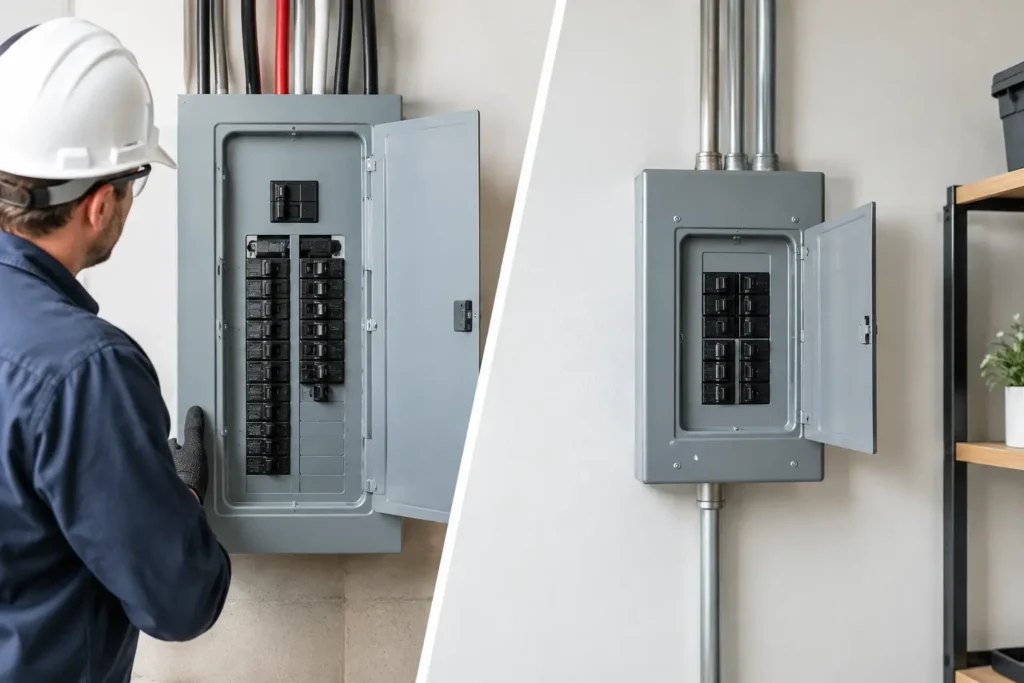
A crowded electrical panel does not automatically mean your home needs more power from the utility. That distinction is at the center of the service upgrade versus subpanel decision. One option increases the amount of electricity your property can receive and distribute. The other adds organized circuit space downstream. Choosing correctly protects your investment, supports modern equipment, and avoids paying for a solution that does not address the actual limitation.
For homeowners in Northern Virginia, the question often comes up during an EV charger installation, renovation, kitchen remodel, generator project, or solar planning conversation. Older homes in McLean, Arlington, Alexandria, Vienna, and Fairfax may have panels that are physically full, undersized for present-day loads, or both. A qualified electrician should evaluate service capacity, load calculations, panel condition, available circuit spaces, and your plans for the next five to 10 years before recommending either path.
Service Upgrade Versus Subpanel: The Core Difference
A service upgrade increases the electrical service capacity supplied to the building. It can involve a new main panel, upgraded service entrance conductors, meter equipment changes, grounding and bonding updates, and coordination with the utility. A move from 100 amps to 200 amps is a common residential example. In some larger homes, workshops, accessory buildings, or commercial settings, 320-amp or 400-amp service may be appropriate.
A subpanel is a secondary distribution panel fed by a breaker in the main service panel. It does not create additional utility capacity. Instead, it gives you more room to install and organize branch circuits. A subpanel might serve a finished basement, detached garage, addition, pool equipment area, or a cluster of new circuits for an EV charger and smart-home equipment.
The simplest way to frame it is this: a service upgrade addresses how much power the property can safely support. A subpanel addresses where circuits are housed and how they are distributed. Sometimes the right project includes both.
When a Subpanel Is the Right Investment
A subpanel can be an efficient, clean solution when the existing electrical service has enough capacity but the main panel has run out of breaker spaces. This is common in homes with a modern 200-amp main panel that has been gradually filled by remodels, appliance replacements, and added technology.
For example, a homeowner may want a 240V Level 2 EV charger in the garage while also planning to finish a basement. If a proper load calculation confirms the 200-amp service can handle the added demand, a garage or basement subpanel may be the most practical design. It keeps circuits close to the equipment they serve and can reduce the need to run numerous individual cables back to the main panel.
Distance matters as well. A detached garage, pool house, workshop, or large addition often benefits from a feeder and subpanel. The subpanel provides a local disconnecting point and leaves room for lighting, receptacles, HVAC equipment, door openers, and future circuits without turning the main panel into a crowded routing point.
A subpanel is not a workaround for an overloaded service. Adding spaces for breakers does not mean there is enough capacity to operate every new load safely. The feeder size, main service rating, calculated demand, and equipment condition still have to support the plan.
Signs a Subpanel May Be Enough
A subpanel may be the right choice when your main panel is relatively modern, the service load calculation has available capacity, and the primary problem is limited breaker space. It is also a strong option when new circuits are concentrated in one area of the property or when you want a more organized distribution layout for a renovation.
The final design should account for the feeder rating, breaker compatibility, panel location, grounding and neutral separation requirements, and local code requirements. These details are not cosmetic. They are what make an expanded electrical system safe, inspectable, and dependable.
When You Need a Service Upgrade
A service upgrade becomes necessary when your existing utility service cannot support your current or planned electrical demand. Many older Northern Virginia homes still have 100-amp service, and some have aging panels or equipment that is no longer suitable for major additions. Modern electrical living can add up quickly: electric ranges, heat pumps, induction cooking, dryers, EV charging, spa equipment, home offices, and battery backup systems all place real demands on the system.
A 200-amp panel is often the practical foundation for an electrified home. It gives homeowners more room to plan for Level 2 charging, all-electric HVAC, solar integration, future battery storage, and a whole-home generator transfer switch. However, 200 amps is not an automatic answer for every property. A large home with multiple HVAC systems, two EVs, a pool, a workshop, or significant electric heat may need a more detailed capacity strategy.
The condition of the existing equipment can also drive the decision. Corrosion, overheating, damaged bus bars, obsolete equipment, improper modifications, or a lack of available main disconnect capacity can make replacement and service modernization the responsible choice. In those cases, adding a subpanel may preserve equipment that should be evaluated for replacement rather than expanded.
What a Service Upgrade Typically Includes
A properly designed service upgrade is more than swapping one panel for another. The scope may include a new main breaker panel, properly sized service conductors, meter-related work, grounding electrode improvements, surge protection, labeling, and permit coordination. Utility involvement may be required depending on the service configuration and local requirements.
For a straightforward residential project, the on-site panel work may often be completed within six to eight hours. The full timeline depends on permitting, utility scheduling, equipment availability, site conditions, and whether service entrance upgrades are required. Professional planning matters because the home will be without power for part of the installation.
Master electrician oversight, permit management, and final inspection are especially valuable here. A service upgrade is foundational infrastructure. It should be installed cleanly, documented clearly, and sized for the property you are building toward, not merely the equipment you own today.
EVs, Generators, Solar, and Battery Backup Change the Math
The service upgrade versus subpanel decision is rarely isolated from the rest of the home. An EV charger may need a dedicated 240V circuit, commonly sized based on the charger output and load calculation. A generator requires a transfer switch or interlock arrangement designed around selected or whole-home loads. Solar and battery systems require carefully planned connections, disconnects, and space for protective equipment.
A subpanel can be ideal for a generator-backed critical-loads panel or a dedicated garage distribution panel. It can also support a focused expansion where service capacity is already sufficient. On the other hand, if you expect to add a Level 2 charger now, replace gas appliances with electric equipment later, and install battery backup after that, a service upgrade may prevent repeated electrical work and avoid design compromises.
Load management technology can sometimes help a property accommodate new equipment without immediately increasing service size. That can be useful, but it should be a deliberate engineered solution, not an assumption. The best answer depends on the actual loads, equipment specifications, lifestyle patterns, and future plans for the property.
How to Make the Right Call
Start with a professional site assessment rather than breaker counting. An electrician should inspect the main panel rating and condition, identify the service conductor and meter configuration, review existing major loads, and perform a code-based load calculation. From there, the decision becomes much clearer.
If the home has adequate service capacity and needs better circuit distribution, a subpanel can be a cost-effective, expandable solution. If the service is undersized, aging, or nearing its calculated limit, a service upgrade delivers the stronger long-term result. If both capacity and circuit space are constrained, combining a service upgrade with a strategically located subpanel can create the cleanest layout.
Voltex Electric approaches these projects as part of a larger power plan, not as a one-size-fits-all panel replacement. That means considering EV charging, renovation plans, backup power, smart-home equipment, and solar readiness before equipment is selected and permits are filed.
Your electrical system should give you options, not force you to postpone the improvements you want. A thoughtful evaluation now can turn a crowded panel into a safe, code-compliant power foundation that is ready for the next chapter of your home.