
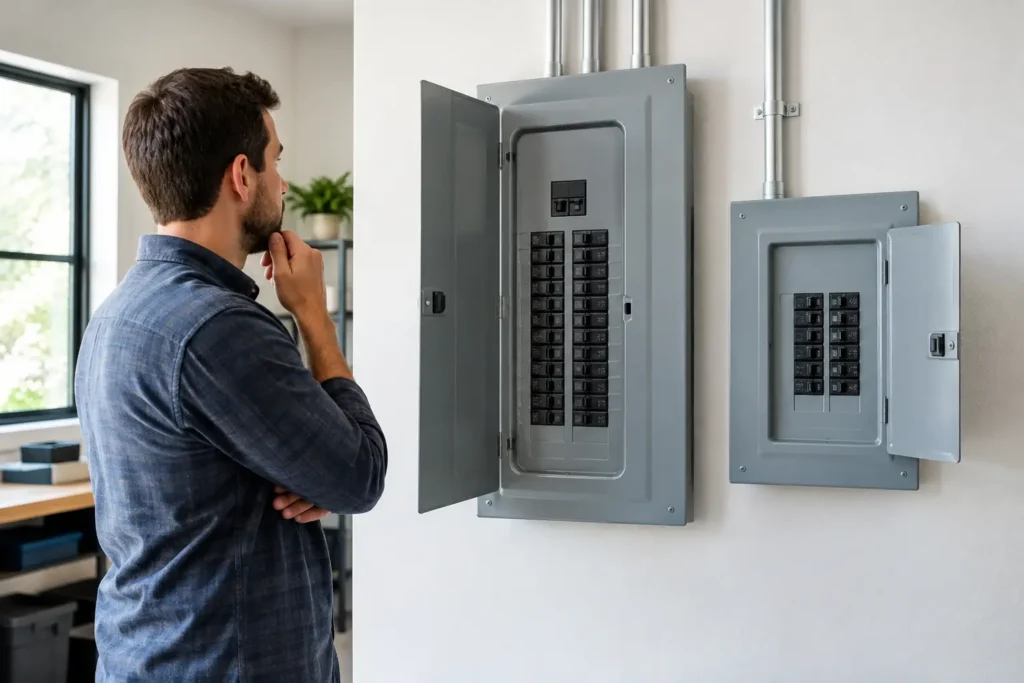
A crowded breaker panel is not automatically a reason to replace it. In the main panel versus subpanel decision, the right answer depends on where power starts, how much electrical capacity the home has, and what you plan to add next. For a Northern Virginia home adding a Level 2 EV charger, finishing a basement, renovating a kitchen, or expanding smart-home equipment, getting that distinction right protects both the project and the property.
What a Main Panel Does
Your main electrical panel is the home’s central distribution point. It receives power from the utility service and sends it through branch circuits to lighting, outlets, appliances, HVAC equipment, and other loads throughout the house. It also contains the main disconnect, allowing power to the entire home to be shut off when necessary.
The main panel is more than a box of breakers. Its service rating – commonly 100, 150, or 200 amps in residential properties – establishes the amount of power the home can safely receive. A larger enclosure with empty breaker spaces does not necessarily mean the electrical service has enough capacity for major new loads.
In many established homes across McLean, Vienna, Fairfax, and Arlington, the panel may have been sized for the way the house was used decades ago. A modern kitchen, two home offices, electric laundry equipment, high-efficiency HVAC, and a 240V EV charger can change the calculation substantially. That is why a licensed electrician evaluates the service equipment, conductors, grounding, panel condition, and actual load before recommending a path forward.
Main panels are where service limitations show up
A main panel may need attention when it is physically damaged, outdated, improperly installed, full with no approved expansion options, or unable to support calculated demand. Warning signs can include breakers that trip repeatedly, corrosion, heat damage, buzzing, flickering lights, or a lack of room for required dedicated circuits.
Some problems are visible. Others are not. A panel can look orderly while its service capacity is already committed. Adding a high-demand circuit without verifying the load calculation is not future-proofing. It is simply moving the risk farther down the line.
What a Subpanel Does
A subpanel is a secondary distribution panel fed from the main panel by a properly sized feeder. It does not increase the amount of utility power available to the property. Instead, it extends circuit space and places circuit control closer to where power is needed.
For example, a homeowner renovating a detached garage may use a subpanel to distribute power for new lighting, receptacles, a door opener, and a dedicated 240V circuit. A basement renovation can benefit from a nearby subpanel rather than running every new circuit back through a crowded main panel. The same approach can make sense for a large addition, workshop, pool equipment area, or outbuilding.
A correctly installed subpanel includes its own breakers, a feeder sized for the intended load, and the proper grounding and neutral configuration. These details matter. In a subpanel, neutral and grounding conductors are handled differently than at the service equipment. That is one reason this work should never be treated as a simple box swap or a homeowner weekend project.
A subpanel solves distance and space problems
The practical value of a subpanel is organization. It can reduce long circuit runs, simplify future additions, and make it easier to shut off power to a defined area during maintenance. For a renovation, it also gives the electrician a clean place to terminate and label the new circuits.
It does not, however, make a 100-amp service perform like a 200-amp service. If the main panel and service cannot support the feeder and the new electrical loads, adding a subpanel is not the solution. The feeder must be protected at the main panel, and the entire system must be designed around real capacity rather than available breaker slots.
Main Panel Versus Subpanel: Which Is Right?
The decision usually comes down to two questions: Does the home have enough overall electrical capacity, and where should the new circuits be located? A subpanel may be the right answer when capacity is available but circuit space or distance is the issue. A main panel upgrade may be necessary when the service itself is undersized, unsafe, obsolete, or unable to carry planned demand.
Consider an EV charging project. A Level 2 charger normally requires a dedicated 240V circuit. If the main service has adequate capacity and the charger is being installed near a detached garage or a remote parking area, a subpanel can be an efficient way to serve that location. If the load calculation shows that the home’s existing service is already near its limit, the conversation shifts to a service and main panel upgrade first.
Kitchen renovations create a similar distinction. Modern code-compliant kitchens need multiple dedicated circuits for countertop receptacles and appliances. If the existing 200-amp main panel is in good condition but has limited usable space, a properly planned subpanel may support the renovation well. If the home has an older, overloaded 100-amp service and several major electrical upgrades planned, replacing the service equipment can deliver a safer long-term result.
Why Breaker Space Is Not the Same as Capacity
Homeowners often count empty spaces and assume the panel can accept whatever comes next. Electrical design is more involved. The panel bus rating, service rating, breaker compatibility, feeder sizing, conductor condition, and calculated load all matter.
A load calculation accounts for how electricity is expected to be used throughout the home. It considers fixed appliances, heating and cooling equipment, cooking loads, laundry equipment, general lighting and receptacle demand, and planned additions such as EV charging. Not every circuit draws its maximum current at the same moment, but that does not eliminate the need for a code-based calculation.
Tandem breakers can sometimes create additional circuit positions in panels specifically listed for them. They are not a universal fix for an overloaded or obsolete panel. Installing breakers that are not approved for the equipment can create safety, inspection, and insurance concerns. A clean, code-compliant installation is worth more than a temporary workaround.
Planning for the Next Project, Not Just This One
The best electrical decisions account for the work you know is coming. If you are renovating now and expect to add an EV charger later, the electrician can size pathways, feeder capacity, and panel space with that next step in mind. If a detached garage may become a workshop, installing the right feeder during current construction can avoid opening finished walls later.
This does not mean every home needs the largest possible panel or subpanel. Oversizing without a clear design purpose adds cost without adding meaningful value. The goal is a system sized for the property, the planned loads, local code requirements, and reasonable future growth.
For many panel upgrades, the work also involves permits, utility coordination where required, inspection scheduling, grounding updates, labeling, and careful protection of the home during installation. A straightforward panel replacement can often be completed in six to eight hours, but service changes, meter work, repairs to existing conditions, or complex renovations may require additional planning.
What a Professional Evaluation Should Include
Before choosing between a main panel and a subpanel, expect a licensed electrician to inspect the existing equipment and discuss the project in practical terms. That includes identifying the panel manufacturer and condition, reviewing available breaker space, calculating demand, evaluating the route for new wiring, and confirming the requirements for permits and inspection.
The result should be a recommendation tied to your home rather than a one-size-fits-all answer. Sometimes the right move is a subpanel that keeps a renovation organized. Sometimes it is a 200-amp panel upgrade that gives the home a safer foundation for modern electrical use. Done right the first time, either option can make future improvements simpler, cleaner, and more predictable.
Need this done at your home? Call Voltex Electric at (703) 944-8653 or request a free quote at voltexelectric.com/contact/ – a licensed master electrician serving Vienna, Fairfax, McLean, Arlington and Northern Virginia.