A flickering fluorescent fixture over a workbench, dim recessed cans in a kitchen, or a parking area with uneven light can make an otherwise well-kept property feel dated. An LED lighting retrofit addresses more than appearance. Done correctly, it improves usable light, reduces energy demand, lowers maintenance needs, and gives the electrical system a cleaner path into the future.
For homeowners and property owners in Northern Virginia, the right retrofit is rarely just a matter of swapping bulbs. Fixture condition, dimmer compatibility, circuit loading, controls, color temperature, ceiling access, and local code requirements all affect the finished result. The goal is not simply brighter lighting. It is lighting designed for how the space is actually used.
What an LED Lighting Retrofit Really Means
An LED lighting retrofit replaces older lighting technology or outdated fixtures with LED equipment while preserving, modifying, or upgrading the existing electrical infrastructure as needed. In a simple case, that may mean replacing compatible lamps and dimmers. In a more complete project, it can involve removing fluorescent troffers, updating recessed lighting, installing new drivers and controls, correcting wiring issues, and adding dedicated circuits for exterior or commercial lighting.
The scope should match the building, not a one-size-fits-all package. A 1980s Fairfax kitchen with undersized recessed cans presents different challenges than an Arlington office with aging fluorescent panels or a Reston retail space with high ceilings. The best approach starts with an on-site assessment of the fixtures, switches, branch circuits, panel capacity, and the light levels needed in each area.
LEDs use significantly less energy than incandescent and fluorescent lighting, but energy savings are only one part of the value. Quality LED fixtures provide more consistent color, start instantly, generate less heat, and can last far longer than older lamps. That means fewer ladder trips to replace failed bulbs in stairwells, garages, warehouses, and exterior fixtures.
Why a Retrofit Needs Electrical Expertise
Lighting looks simple because it is familiar. The work behind it is not always simple. Older homes and commercial buildings can have deteriorated insulation, loose connections, overloaded lighting circuits, ungrounded wiring, obsolete dimmers, or fixtures installed around conditions that no longer meet current requirements.
A professional electrician evaluates the circuit before installing new equipment. If a switch box has no neutral conductor, for example, some smart switches and occupancy sensors may not be appropriate without additional wiring. If recessed fixtures are buried under insulation or placed too close to combustible materials, replacement requires careful attention to fixture ratings and clearances. In commercial settings, emergency lighting, exit signs, occupancy controls, and accessibility requirements may all factor into the design.
Retrofitting is also a useful opportunity to identify wider electrical needs. A homeowner planning a kitchen renovation may discover that the lighting circuit shares capacity with older receptacles, while a business owner may find that a panel has limited space for future equipment. Addressing those issues during a planned project is often cleaner and more cost-effective than reopening finished walls later.
Choosing the Right Light, Not Just More Light
Brightness is measured in lumens, not watts. That distinction matters because low wattage does not automatically mean adequate illumination. A kitchen prep area, home office, garage workbench, reception desk, and exterior walkway each require different light levels and fixture placement.
Color temperature deserves equal attention. Warm white lighting around 2700K to 3000K generally works well in living rooms, bedrooms, and traditional interiors. Neutral light around 3500K to 4000K is often better for kitchens, bathrooms, garages, offices, and task-oriented spaces. Cooler temperatures can work in certain commercial or security applications, but excessively blue-white light can feel harsh in a home.
Color rendering index, or CRI, affects how accurately colors appear under a fixture. Higher-CRI lighting is particularly worthwhile around kitchen counters, closets, bathrooms, retail displays, and finished materials where homeowners or customers need to distinguish color clearly. A paint sample, clothing, cabinetry, or food can look noticeably different under poor-quality lighting.
Fixture placement matters as much as fixture selection. Recessed cans spaced too far apart create pools of light and dark edges. Under-cabinet lighting should illuminate the counter rather than shine into someone’s eyes. Exterior lights should improve safety at doors, steps, and driveways without creating glare for neighbors. Good lighting design respects the room, the architecture, and the people using it.
Retrofit Options for Homes and Businesses
For a home, an LED lighting retrofit often focuses on recessed lighting, kitchens, bathrooms, garages, basements, exterior entries, landscape lighting, and security lighting. Many homeowners also replace older ceiling fixtures during renovations or add layered lighting with recessed fixtures, pendants, and under-cabinet task lighting. The result is a more useful space without relying on a single central fixture.
Commercial projects frequently involve fluorescent-to-LED troffer replacements, warehouse high bays, office lighting, parking-lot fixtures, retail displays, emergency lighting, and occupancy sensors. The savings can be substantial when lights operate for long hours, but light distribution remains the priority. A poorly selected high-bay fixture may be efficient and still leave aisles or work surfaces inadequately lit.
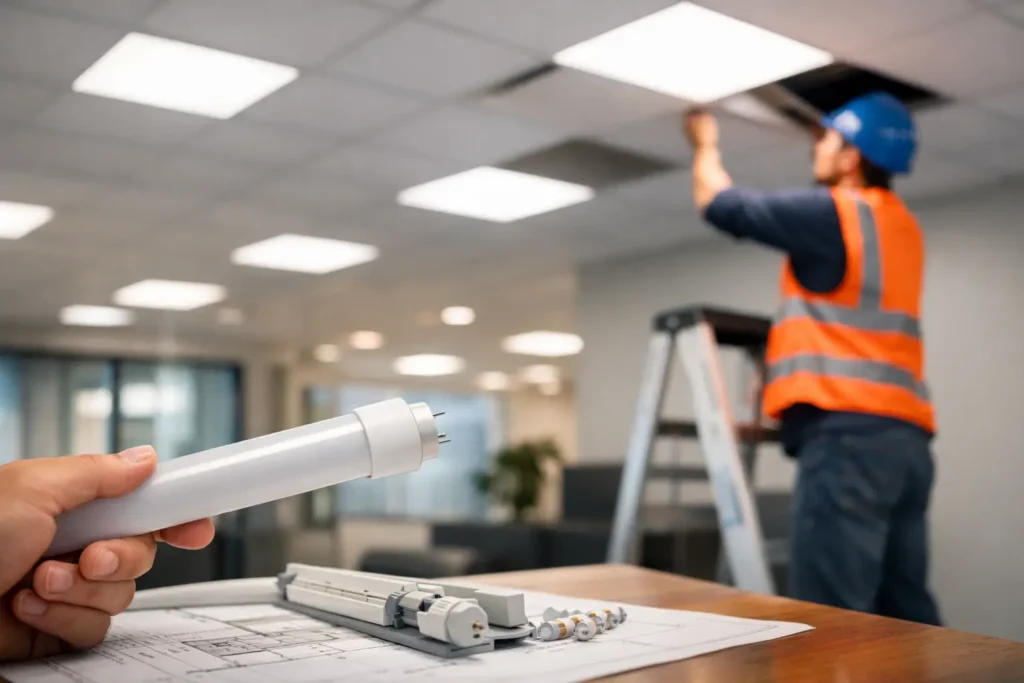
There are two broad paths for older fluorescent fixtures. A ballast-compatible LED tube can offer a faster update in the right application. A ballast-bypass conversion removes the ballast and rewires the fixture for direct-wire LED tubes. Full fixture replacement can be the better long-term choice when housings are damaged, lenses are yellowed, or a cleaner appearance and better optical performance are needed.
Each option has trade-offs. Keeping an old fixture may lower upfront cost, while a new integrated LED fixture can improve reliability and appearance. Integrated fixtures can also make future driver replacement more specialized. The right choice depends on fixture condition, operating hours, budget, ceiling type, and how long the property owner expects to keep the space.
Controls Make the Upgrade Work Harder
LED lighting pairs well with modern controls, but compatibility must be planned. Dimmers should be rated for the specific LED load. An incompatible dimmer can cause flickering, buzzing, limited dimming range, or lights that glow faintly after being switched off. The cheapest device is rarely the best choice when it creates daily frustration.
Occupancy sensors are practical in closets, laundry rooms, bathrooms, garages, storage rooms, and commercial back-of-house areas. Photocells and timers can manage exterior lighting according to daylight and operating schedules. Smart switches may provide app control, scenes, scheduling, and integration with broader home automation systems, provided the wiring and network plan support them.
For larger homes and businesses, controls also reduce the tendency to leave lights running unnecessarily. That benefit is strongest when the system stays intuitive. A conference room or family room should not require a manual to turn on the lights.
Electrical Capacity, Permits, and Clean Installation
Although LED fixtures reduce lighting loads, a retrofit can still involve meaningful electrical work. New recessed lighting, exterior circuits, low-voltage transformers, smart controls, and commercial upgrades may require circuit modifications, box changes, permits, and inspections. Older properties can also expose wiring conditions that should not be covered back up without correction.
A master-electrician-led installation protects more than the fixtures themselves. It confirms proper grounding, secure connections, box fill, conductor sizing, breaker protection, and equipment ratings. It also keeps the project aligned with applicable code and inspection requirements. For a larger renovation, lighting should be coordinated with panel upgrades, 240V appliance circuits, Level 2 EV charging, generator equipment, and solar-ready planning so the electrical system grows in an organized way.
At Voltex Electric, the process begins with the way the property is used now and where it is heading next. A clean retrofit plan accounts for access, wall and ceiling protection, fixture layout, controls, permits, and the future electrical loads that may follow. That is how lighting work becomes part of a properly modernized power system rather than an isolated cosmetic update.
When It Makes Sense to Retrofit
A retrofit is especially timely when lights flicker, fluorescent lamps are becoming harder to source, fixtures run hot, rooms feel dim despite high energy use, or a renovation has opened ceilings and walls. It also makes sense before listing a property, preparing a commercial space for a new tenant, adding a home office, or improving security around exterior doors and walkways.
Do not assume every old fixture must be replaced immediately. A well-maintained decorative fixture may only need an appropriate LED lamp and compatible dimmer. But when several fixtures are failing, the layout is poor, or wiring work is already planned, treating the lighting as a complete system usually produces a better and longer-lasting result.
The most valuable LED lighting retrofit is one you stop thinking about after it is installed: the kitchen is easier to work in, the office is more comfortable, the entry feels safer, and the electrical work is ready for what the property needs next.