A breaker that trips once can be a nuisance. A breaker that trips repeatedly in a medical office, retail space, restaurant, warehouse, or multi-tenant building is a warning that deserves a professional response. Commercial electrical maintenance services help property owners identify those warnings before they become lost operating hours, damaged equipment, failed inspections, or a safety event.
For Northern Virginia businesses, electrical maintenance is not simply about keeping lights on. It is about protecting the power capacity behind HVAC equipment, refrigeration, network closets, point-of-sale systems, security equipment, EV charging, tenant improvements, and the growing number of loads modern properties depend on. The right maintenance plan combines field inspection, documented testing, code-aware repairs, and a clear view of what the building will need next.
What Commercial Electrical Maintenance Should Cover
Commercial electrical systems age under real working conditions: heat, vibration, moisture, dust, heavy motor loads, utility fluctuations, and years of additions made for new tenants or equipment. A maintenance visit should look beyond the most visible problem and evaluate the condition of the distribution system as a whole.
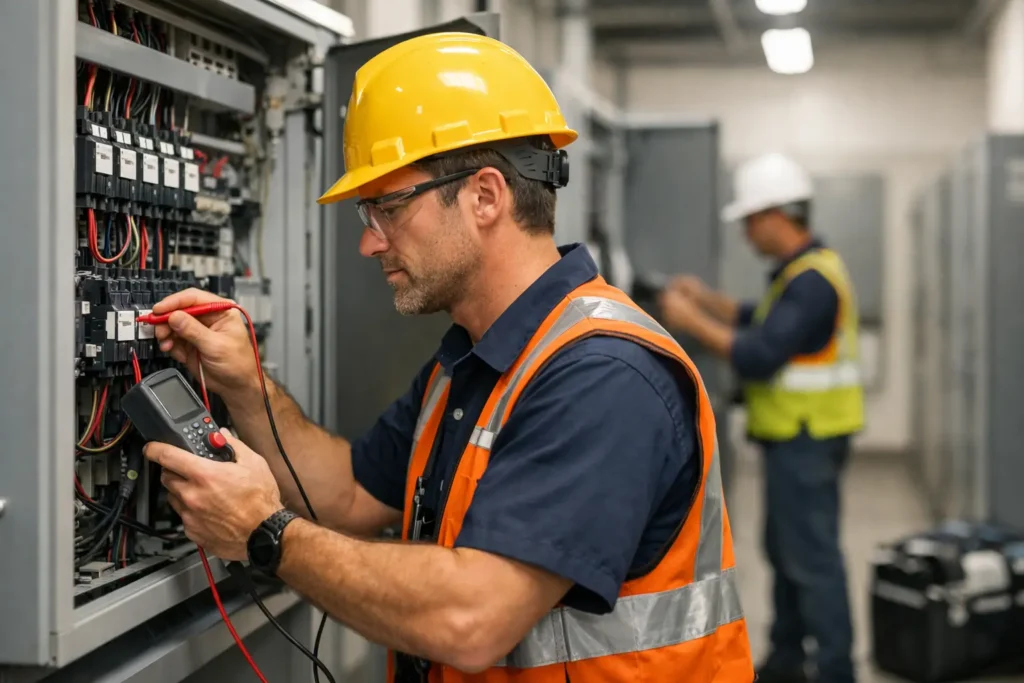
That starts at the service equipment and main distribution panel. A qualified electrician checks for signs of overheating, corrosion, loose terminations, damaged breakers, improper labeling, open knockouts, water intrusion, and circuits that no longer match the panel schedule. These details matter. A loose connection can create resistance and heat long before a breaker trips, while unclear labeling slows down safe troubleshooting during an outage.
From there, the inspection should extend to subpanels, disconnects, receptacles, switches, lighting controls, emergency lighting, exterior fixtures, dedicated equipment circuits, and accessible wiring pathways. In older buildings, it may also include evaluating whether previous modifications created overloaded circuits, unsuitable equipment connections, or capacity limitations that are not obvious during normal operation.
A useful maintenance report separates immediate safety repairs from recommended upgrades and longer-term planning. Not every aging component requires replacement today. The decision depends on its condition, its criticality to operations, available capacity, manufacturer support, code requirements, and the owner’s plans for the property.
Why Reactive Repairs Cost More Than Planned Maintenance
Waiting until something fails often turns a manageable repair into an urgent disruption. A failed disconnect can shut down rooftop HVAC. An overloaded branch circuit can take a server rack or kitchen appliance offline. A lighting issue in a parking area can affect security and tenant safety. Emergency service has its place, but it is rarely the best time to make a careful equipment decision.
Planned commercial electrical maintenance services give owners more control. Work can be scheduled around business hours, tenant access, seasonal demand, and required shutdown windows. Repairs can be quoted clearly before they become emergencies, and replacement equipment can be selected for the actual load instead of whatever is immediately available.
This approach is especially valuable for properties that have changed use. A suite that once supported basic office equipment may now have high-density workstations, multiple displays, commercial printers, AV systems, dedicated cooling, and Level 2 EV charging. The electrical system may still function, but its safety margin and available capacity may be far different than the original design intended.
The Warning Signs Property Owners Should Not Ignore
Some electrical problems announce themselves clearly. Others develop gradually and get normalized by staff until they become expensive. Call for an assessment when a panel feels warm, breakers trip repeatedly, lights flicker or dim when equipment starts, outlets are loose or discolored, or a burning odor appears near electrical equipment.
Other concerns are operational rather than dramatic. You may be planning a tenant build-out, replacing gas equipment with electric models, adding a 240V appliance, installing exterior lighting, or preparing parking areas for EV chargers. These projects should begin with a capacity review, not just an installation quote. Adding a new circuit is straightforward only when the upstream service, panel, feeder, and available breaker space can support it.
Older panels, obsolete electrical equipment, water exposure, and unlabeled circuits also warrant attention. In a commercial setting, uncertainty itself carries a cost. If no one can confidently identify what a breaker serves, a small repair can require a larger shutdown than necessary.
Electrical Capacity Is a Business Decision
Capacity planning is where routine maintenance becomes future-proofing. A building may have a 200A, 400A, or larger service, but the service rating alone does not explain how much usable capacity remains. An electrician must evaluate calculated demand, existing loads, feeder sizes, panel ratings, and the load profile of planned equipment.
For example, a Level 2 EV charger commonly requires a dedicated 240V circuit. Several chargers at a workplace may require load management, additional distribution equipment, or a service upgrade. The same is true when adding electric heat, commercial kitchen equipment, battery backup, or new HVAC. A well-designed solution may be a panel upgrade, a new subpanel, a feeder upgrade, or a phased plan that avoids spending ahead of actual demand.
A Practical Maintenance Schedule for Commercial Properties
The right inspection frequency depends on the building and its electrical loads. A small professional office with stable occupancy may need an annual review and prompt service when changes occur. A restaurant, light industrial facility, medical practice, property with outdoor equipment, or multi-tenant building generally benefits from more frequent attention because its electrical use is heavier or its operating risk is higher.
At a minimum, commercial owners should schedule a professional review after major renovations, new equipment installations, water events, utility damage, recurring breaker trips, or occupancy changes. Seasonal inspections are also sensible for systems that support high summer cooling loads, exterior lighting, generators, or equipment exposed to weather.
During each visit, documentation should be part of the deliverable. Updated panel directories, identified circuit issues, photographs of material concerns, and recommended corrective actions make future decisions easier. They also help owners coordinate with tenants, facility managers, inspectors, and other trades without relying on incomplete memory or handwritten notes from years ago.
Maintenance, Code Compliance, and Inspections
Maintenance is not a substitute for permits when a project requires them. New circuits, service upgrades, panel replacements, generator connections, and many tenant improvement projects need proper permitting and inspection under local requirements. A professional electrical contractor should explain the scope, manage the permit process where applicable, and install equipment to current code requirements.
That distinction protects owners. A quick repair may restore operation, but an unpermitted modification can create complications during an inspection, insurance review, property sale, or future renovation. It can also leave the next electrician trying to determine whether conductors, overcurrent protection, grounding, and disconnecting means were selected correctly.
Master-electrician supervision brings particular value to complex commercial work because the system must be evaluated as an interconnected whole. The objective is not merely to replace a failed part. It is to correct the cause, preserve safe operation, and avoid creating the next bottleneck upstream or downstream.
Choosing a Commercial Electrical Maintenance Partner
The best contractor for ongoing maintenance is not always the lowest initial quote. Commercial properties need clear communication, clean job sites, dependable scheduling, accurate documentation, and technicians who understand how to work around occupied spaces. They also need a contractor willing to say when a repair is sufficient and when an upgrade is the more responsible choice.
Ask how the contractor handles troubleshooting, permits, inspections, shutdown planning, and equipment selection. Confirm that the company can support both immediate repairs and larger modernization work, including panel capacity upgrades, lighting, dedicated 240V circuits, generator transfer switches, battery backup, and EV infrastructure. That breadth prevents owners from treating every new electrical need as an isolated project.
Voltex Electric approaches commercial maintenance with that long-term view. Our teams assess the condition of the equipment in front of them while planning for the loads your property may carry next, with master electrician quality and professional accountability at every stage.
A well-maintained electrical system should fade into the background of your operation. Schedule an assessment before the next expansion, seasonal peak, or equipment failure forces the decision, and you can make improvements on your timeline instead of during an outage.